Versatile hoopers training with just a few obstacles
How many different hoopers exercises can you create using the same obstacles? Even a small number of obstacles can offer plenty of opportunities to practise different skills, without having to rebuild the setup between exercises. Short exercises are also ideal when training space is limited, especially during the winter months.
A single training setup can provide several exercises with different goals and levels of difficulty. By changing your dog's starting position, the distances between obstacles, or your own position, you can work on different skills or develop skills your dog has already learned.
Training with fewer obstacles also makes it easier to focus on exactly what you want to reinforce in your dog's performance and plan your rewards accordingly. In this article, we'll explore how to get more out of exercises using 1-6 obstacles and how to plan exercises around different training goals.
What can you practise with 1-6 obstacles?
Short exercises are great for strengthening individual skills, but they don't have to mean repeating the same obstacle or task over and over again.
With just a few obstacles, you can practise:
Working at a distance
Maintaining a line
Adjusting a line
Building your dog's confidence
Turning cues
Different tasks involving obstacles that the dog goes around
Discriminating between different tasks
Start-line routines
Rewarding skills
Handler skills
The same obstacle setup can provide opportunities to work on a wide range of skills. The important thing is to identify exactly what you want to reinforce in each exercise.
If you're looking for more ideas on how to make use of ready-made obstacle setups, you might also enjoy One Hoopers Setup - 50 Possibilities to Adjust It.
Plan your training around the skills you want to strengthen
When planning a training session, it's easy to start with a ready-made course plan and only then think about what you could practise with it. Sometimes, however, it's worth looking at your training more broadly before choosing your next exercise.
Think about which skills your dog is already confident with and where there is still room for improvement. What have you noticed in your recent training sessions? Has a particular task repeatedly been challenging, or has a certain skill received less attention? What skills will you need to develop to progress towards your next goals?
Based on these observations, you can choose one or a few skills to focus on in your upcoming training sessions. This way, your training becomes more than a collection of unrelated exercises, and individual sessions support your longer-term goals.
Once you've identified your training priorities, you can consider which exercises would best help strengthen those skills. For example, if you want to develop a particular skill, think about where your dog is in the learning process. Does the task still need more reinforcement on its own, or is your dog ready to practise it as part of a discrimination exercise?
When you know what you want to reinforce, it's easier to choose a suitable obstacle setup, adjust the difficulty of the exercise, and evaluate whether your training is producing the progress you're looking for.
One training setup, three different goals
In this section, you'll find an obstacle setup and three examples of how to use it for different training goals, beyond simply strengthening an individual skill.
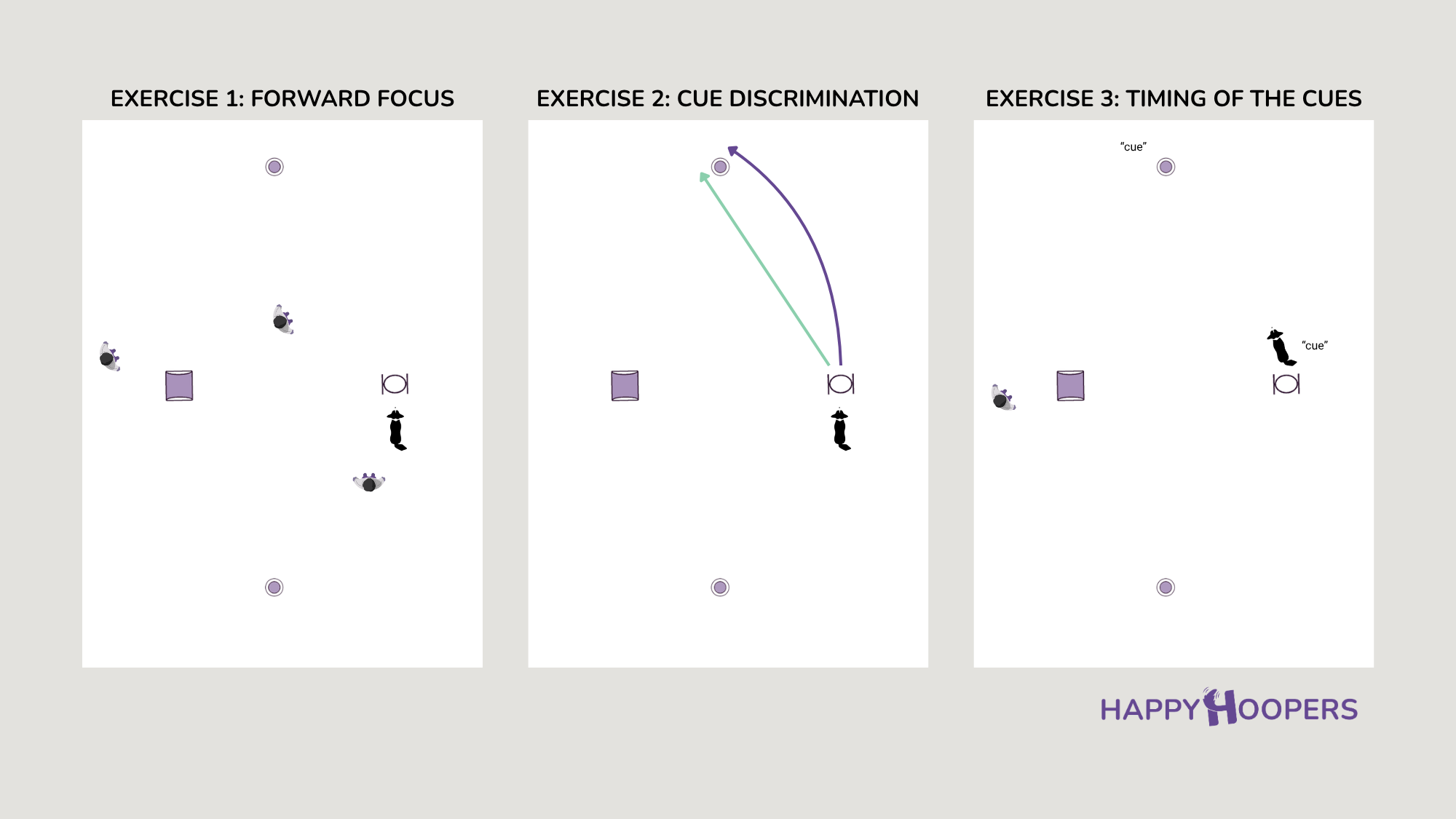
This exercise base and plenty more can be found from Hoopers - Training ideas for 1-6 obstacles ebook
Exercise 1: Forward focus
The goal of this exercise is to strengthen your dog's ability to shift their focus to the task ahead, regardless of the handler's position.
Your dog's starting position and task remain the same, but you vary your position as the handler. You can start from a position that is easy for your dog and gradually move to more challenging positions, or alternate between easier and more difficult ones.
Observe whether your position affects your dog's ability to shift their focus forward. Can your dog focus on the task ahead even when you're in a more challenging position? Plan your rewards to support the development of this skill.
Exercise 2: Cue discrimination
The goal of this exercise is to strengthen your dog's ability to discriminate between different turning cues.
Your dog's starting position and your position as the handler remain the same, but you vary the turning cue you give. For example, you can practise discriminating between tight and wide turns or choose other turning cues your dog is already familiar with.
Vary the cues throughout the exercise and observe how your dog responds. Does your dog perform the turn indicated by the cue, or do they anticipate the task based on the previous repetition? Plan your rewards to reinforce responding correctly to each cue.
Exercise 3: timing of the cues
The goal of this exercise is to develop your ability as a handler to recognise when your dog needs a cue, giving them enough time to respond and perform the requested task safely.
Choose a task from the obstacle setup and, before starting, identify where you think you should give the handling cue. Also consider whether your dog's speed, line, or the distance between obstacles affects the timing of the cue.
Try the exercise and observe how your dog responds to the timing of your cue. You can also change the distance between obstacles and explore how this affects both your cue timing and your dog's performance.
Change one thing at a time
When your dog is still learning a skill, it's worth increasing the difficulty gradually. One of the principles of shaping in animal training is to raise criteria in small steps and focus on one aspect of behaviour at a time (Pryor - The Ten Laws of Shaping).
In hoopers training, you might increase the distance between yourself and your dog, increase or decrease the distance between obstacles, or add a distracting obstacle. However, it's best not to make all of these changes more challenging at once, especially if the skill you're working on isn't yet well established.
By changing one thing at a time, you give your dog a better chance of succeeding and make it easier to see how each change affects their performance. If an exercise becomes too difficult, it's also easier to identify what you should make easier next.
From short exercises to longer sequences
Once an individual skill is becoming reliable in a short exercise, you can start combining it with other tasks. At this stage, your training goal might be to strengthen your dog's ability to perform a familiar skill in different situations.
For example, can your dog perform the same turn when another obstacle comes before it? Can your dog continue to the next obstacle after the turn? Does the task become more difficult if you stay further away? What happens if you add layering another obstacle to the exercise?
Just because your dog can perform a skill close to you or as an individual task doesn't necessarily mean they can perform it as part of a longer course or at a greater distance. That's why it's worth combining tasks gradually and observing how your dog responds as the difficulty increases.
Ready-made hoopers training ideas with 1-6 obstacles
You don't always have to plan every exercise from scratch. A ready-made exercise can provide a starting point that you can adapt to your dog's skill level and training goals.
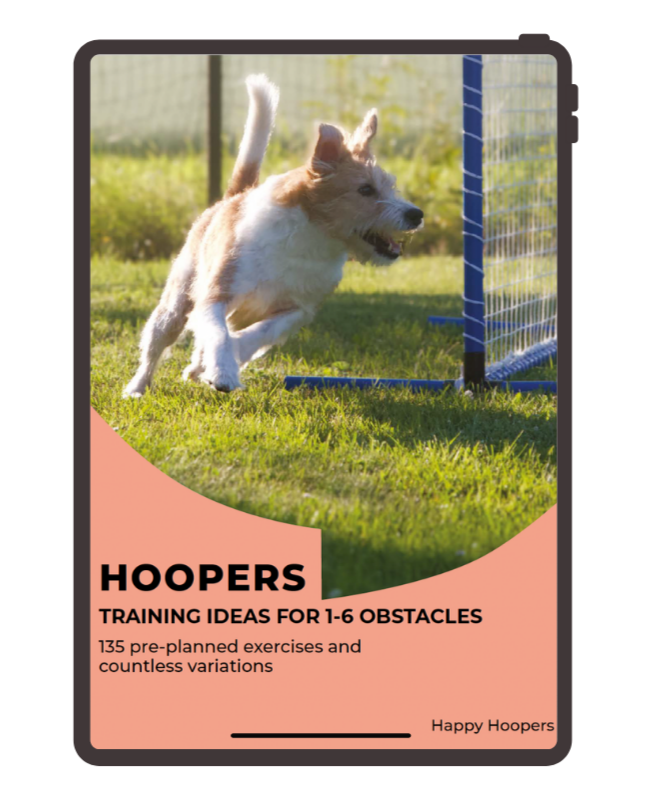
HOOPERS - Training Ideas with 1-6 Obstacles is a digital exercise book containing 135 training ideas that use only a small number of obstacles.
You can follow the exercises as they are, adapt them to strengthen different skills, combine tasks, or use them as inspiration when designing your own courses.
Explore HOOPERS - Training Ideas with 1-6 Obstacles HERE
Happy Hoopers - for hoopers handlers and coaches
Happy Hoopers is a site designed for hoopers enthusiasts and coaches. Here you’ll find information about the sport, ideas to inspire your training, and insights that go a little beyond hoopers itself. All with the goal of helping you and your dog enjoy the journey together.
The site was founded by Tiina Wikström, a hoopers instructor, coach trainer, and mental performance coach. Tiina is passionate about supporting handlers and coaches in creating positive, motivating, and enjoyable training experiences for both dogs and humans.
Whether you’re just starting your hoopers adventure or you’re an experienced trainer looking for fresh perspectives, Happy Hoopers is here to spark your creativity and keep your sessions fun and purposeful.
Learn more: www.happyhoopers.fi