Practising individual skills is an important part of hoopers training, and so is teaching your dog to put those skills together into longer sequences. There are several ways to approach this.
In this article, we'll look at three ways to build longer hoopers sequences: target training, backward chaining and forward chaining. We'll explore when each approach might be useful and what to consider when planning your training.
What is behaviour chaining?
In animal training, chaining means linking individual behaviours together to form a longer sequence, known as a behaviour chain. Each behaviour leads into the next, and the cue for the next behaviour can also act as a reinforcer for the one before it.
In hoopers, a simple three-part chain might involve turning after a hoop, going around a barrel and continuing through another hoop.
Chaining is easier when your dog is already familiar with the individual skills involved. If a particular skill is still being developed, spending some time strengthening it separately can make it easier to include in a longer sequence later.
As a handler, it's useful to recognise which skills your dog can perform confidently and which ones need more practice.
For ideas on developing individual skills, you might also enjoy our article Versatile hoopers training with just a few obstacles.
Three ways to build longer sequences
#1 Using target training to connect tasks
Target training can be a useful tool when teaching your dog to link individual hoopers tasks together. A target mat, for example, can help develop distance work, maintain a particular line and encourage your dog to continue from one task to the next.
You could place a mat after two hoops and reward your dog for running over it and continuing towards the next task.
One thing to keep in mind is that your dog may start relying on the visible target. It's worth practising with and without the mat, alternating between the two and observing how your dog's performance changes.
#2 Backward chaining
With backward chaining, you begin by teaching the final part of a sequence. Once that part is working well, you add the preceding task and gradually build the sequence backwards towards the beginning.
For example, imagine a sequence where your dog goes around a barrel, runs through two hoops and then receives a reward. You could start by practising the final hoop and rewarding your dog afterwards. Next, add the preceding hoop, and finally include the barrel.
One advantage of backward chaining is that your dog becomes familiar with the end of the sequence. Each stage finishes with the same familiar tasks leading to a reward, making the ending predictable.
Backward chaining does require some planning, particularly when it comes to your position as a handler.
If your dog needs to start a task a considerable distance away from you, they must already be confident starting independently from that position. Otherwise, the starting position itself may become the main challenge, rather than linking the tasks together.
#3 Forward chaining
With forward chaining, you begin with the first task in the sequence and reward your dog in the direction of the next task. Once that is working well, you add the next task and again reward along the intended line of travel.
Forward chaining can be a useful approach when you want to develop a particular line or strengthen your dog's ability to continue independently from one task to the next.
It can also allow you to begin from easier starting positions, especially when your dog would find it difficult to start far away from you, as might be required with backward chaining.
As you progress, consider practising different parts of the sequence separately rather than continually adding more obstacles. You can then bring those parts together into a longer sequence when your dog is ready.
How do you choose the right approach?
Different sequences may benefit from different training approaches. Your choice will depend on your dog's current skills, your training goals and the tasks involved.
Before starting, consider a few questions:
Can your dog perform the individual tasks confidently with you in different handling positions?
Which parts of the sequence might require more support from you?
Where and how will you reward your dog?
How could you make the exercise easier or more challenging if needed?
If your dog struggles to connect two tasks, observe what happens after the first one. Backward chaining may be a useful option when you're close to your dog and can practise the final part of the sequence from an easier starting position.
If the exercise requires your dog to start a considerable distance away from you, forward chaining may be more practical. With backward chaining, your dog would also need to be confident starting independently at a distance so that you can focus on connecting the tasks.
There's no need to keep making every sequence longer. Shorter exercises are valuable throughout your dog's training. You can revisit individual skills, practise different combinations and vary your handling position to develop greater confidence and independence.
For more ideas on adapting exercises to suit your training goals, read One Hoopers Setup - 50 Possibilities to Adjust It.
Longer sequences challenge your handling skills too
As you begin linking more tasks together, planning and anticipation become increasingly important for you as a handler.
With a single task, you may have plenty of time to give your cue. In a longer sequence, your dog might need the next handling cue before completing the previous obstacle, or immediately afterwards.
When planning an exercise, consider your dog's line, speed and the distances between obstacles. When does your dog need the next cue? How does your position affect their performance? Where would rewarding be most useful for the skill you're working on?
You can also practise your own handling skills separately. For example, study the course plan and mentally rehearse your cue timing before running the exercise with your dog.
Ready-made hoopers exercises with 5-8 obstacles
When you're ready to combine individual skills into longer sequences, ready-made course layouts can make planning easier and give you fresh ideas for different combinations of tasks.
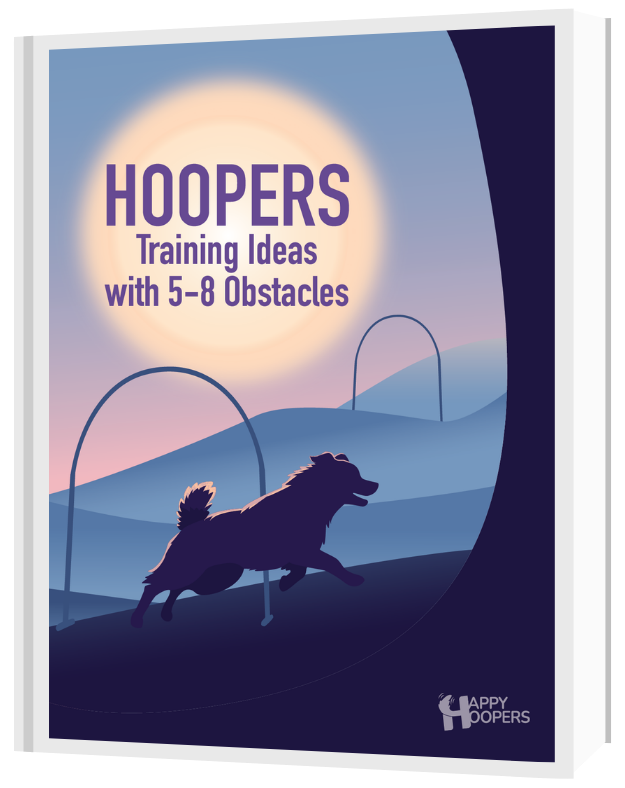
HOOPERS - Training ideas with 5-8 obstacles is a digital exercise book featuring 78 training exercises. You can use the exercises as they are, break them into shorter sections or adapt them to suit your dog's skills and your training goals.
Each layout offers opportunities to work on different skills, depending on how you choose to use it.
Explore HOOPERS - Training ideas with 5-8 obstacles HERE
Happy Hoopers - for hoopers handlers and coaches
Happy Hoopers is a site designed for hoopers enthusiasts and coaches. Here you’ll find information about the sport, ideas to inspire your training, and insights that go a little beyond hoopers itself. All with the goal of helping you and your dog enjoy the journey together.
The site was founded by Tiina Wikström, a hoopers instructor, coach trainer, and mental performance coach. Tiina is passionate about supporting handlers and coaches in creating positive, motivating, and enjoyable training experiences for both dogs and humans.
Whether you’re just starting your hoopers adventure or you’re an experienced trainer looking for fresh perspectives, Happy Hoopers is here to spark your creativity and keep your sessions fun and purposeful.
Learn more: www.happyhoopers.fi