Results of the Stride Challenge - What did we learn about how dogs move?
We wanted to deepen our understanding of how dogs of different sizes and structures move in hoopers. In a previous survey about Small Dogs in Hoopers, many respondents felt that size noticeably affects how challenging courses and training can be for smaller dogs.
That insight inspired us to launch the Stride Challenge. All responses (150) were collected anonymously, and the purpose of the challenge was to gather information about how dogs of various sizes move through a predefined obstacle setup. Please note that the results are indicative and not part of a scientific study.
A big thank you to everyone who took part. Many participants mentioned how interesting the challenge felt, and we have also received plenty of challenge videos to review and learn from.
This is the third part of the Small Dogs in Hoopers series, created by Tiina Wikström from Happy Hoopers and Tiinamari Harjula from Tiima Dog Sport.
Respondents
The highest number of responses came from Finland (124) and Estonia (19). In addition, there were four responses from the Netherlands and one each from Canada, Italy and Germany.
The respondents’ dogs represented the following breeds:
Border Collie 28
Australian Kelpie 11
Shetland Sheepdog 9
Mixed Breed 9
Prague Ratter 8
Australian Shepherd 6
Miniature American Shepherd 5
Poodle 5
Chihuahua 4
Papillon 4
Welsh Corgi Cardigan 4
Kooikerhondje 3
Labrador Retriever 3
Lapponian Herder 3
Mudi 3
Spanish Water Dog 2
Golden Retriever 2
Miniature Pinscher 2
Mittelspitz 2
Schipperke 2
Shiba Inu 2
Siberian Husky 2
Finnish Hound 2
These breeds were represented by one dog each: Australian Terrier, Beagle, Border Terrier, Brazilian Terrier, Cavalier King Charles Spaniel, Cocker Spaniel, English Setter, English Springer Spaniel, Irish Setter, Irish Water Spaniel, Icelandic Sheepdog, Standard Poodle, Jack Russell Terrier, Kleinspitz, Kromfohrländer, Landseer, Malinois, Dachshund, Nova Scotia Duck Tolling Retriever, Parson Russell Terrier, Rough Collie, Pyrenean Shepherd, Rhodesian Ridgeback, Smooth Collie, Flat-Coated Retriever, Staffordshire Bull Terrier, Finnish Lapphund, Tenterfield Terrier and Russian Hound.
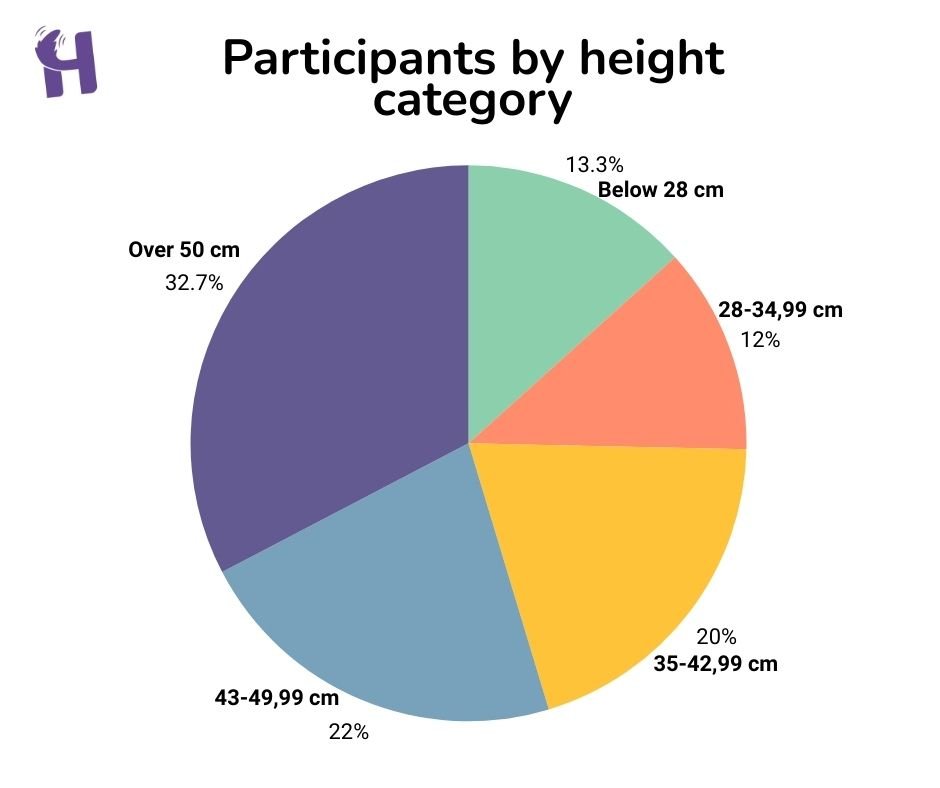
Of the respondents, 116 (about 77 percent) provided their dog’s exact height at the withers. The average height was 42 cm. The smallest participant measured 18 cm and the tallest 67 cm. One quarter of the participating dogs were under 35 cm tall and one quarter were over 52 cm tall.
Challenge setup
In this challenge, the dog was instructed to run through three hoops placed in a straight line, with 6 meters between each hoop according to the given guidelines. From each run, participants recorded the number of strides the dog took as well as the total time of the performance.
You can view the full challenge instructions HERE.
Results
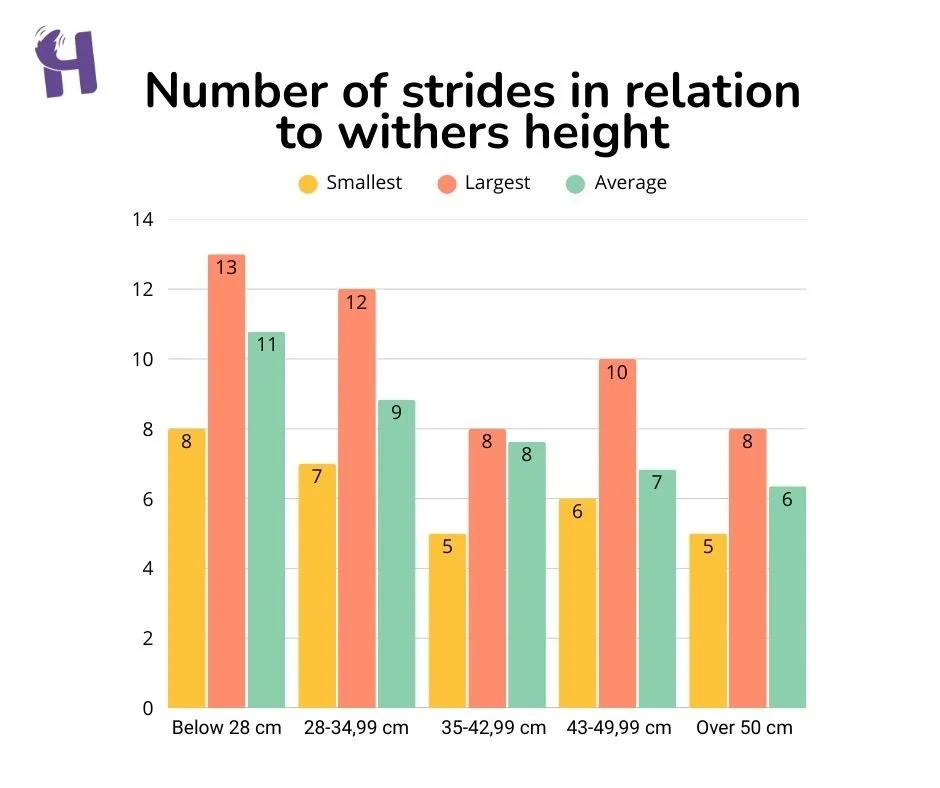
The number of strides recorded ranged from 4 to 13. The average number of strides across all responses was 7, which was also the most common value.
Dogs under 28 cm took 8-13 strides (average 10.8),
dogs measuring 28-34.99 cm took 7-12 strides (average 8.8),
dogs measuring 35-42.99 cm took 5-9 strides (average 7.6),
dogs measuring 43-49.99 cm took 6-10 strides (average 6.8),
and dogs over 50 cm took 5- strides (average 6.4).
Performance times ranged from 1.3 to 4.5 seconds. The overall average time across all participants was 2.23 seconds. Most runs lasted between 1.9 and 2.4 seconds.
You can see size-category differences in the table below.
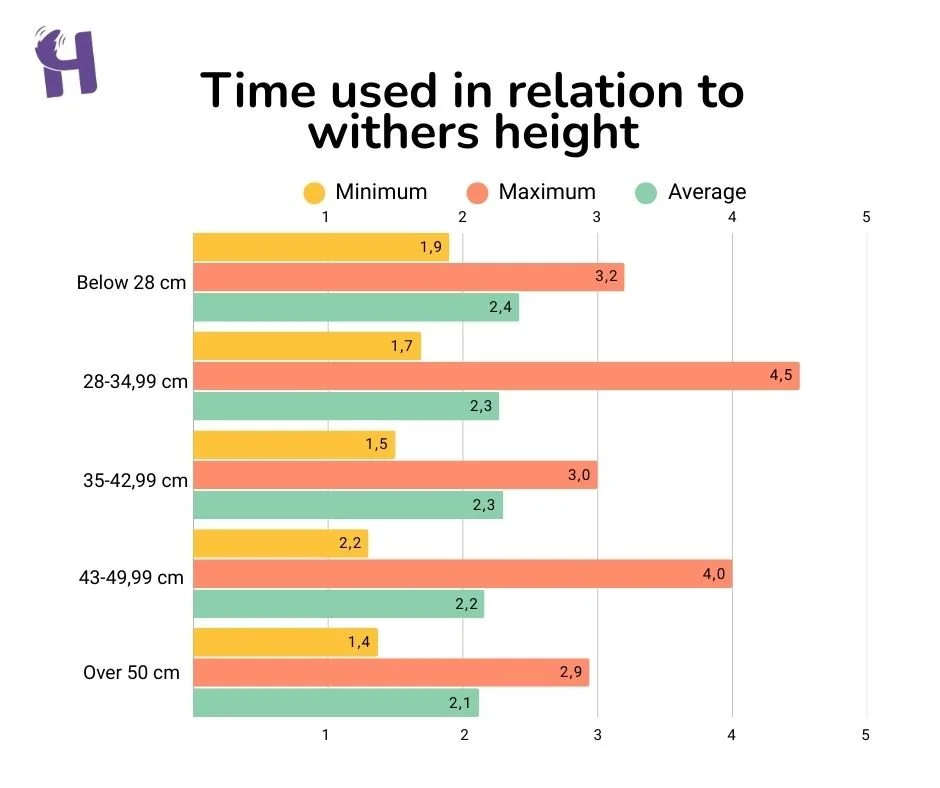
Based on the results, we can conclude that the more strides the dogs took, the longer their running time became. When the dogs took 5-6 strides, the average time was around 2 seconds. With 7 strides, the average time increased to about 2.2 seconds. Dogs taking 9-10 strides completed the sequence in approximately 2.4 seconds, while those taking 13 strides reached an average of 2.9 seconds.
Disclaimer - Important points to keep in mind when interpreting the results
The Stride Challenge was designed so that it could be carried out indoors during the winter season, in training spaces that vary greatly in size. This naturally introduces several factors that may influence the results and that are worth remembering.
Test setup
The space, surface and available equipment can all affect how a dog moves. Participants filmed the challenge on different surfaces and used both hoops with and without bars. To make counting strides as easy as possible, the first hoop was chosen as the starting point, so the first stride always begins at the hoop. The number of hoops and the distance between them were selected to ensure that most people could film the entire sequence on a phone without needing an additional camera person.
Dogs starting position
All dogs started the challenge from a stationary position at the first hoop. Each dog accelerates differently, and their explosiveness and ability to reach full stride vary. This means the challenge does not fully reflect situations where the dog is already in motion before entering the sequence.
Accuracy may vary
Counting strides from video, even in slow motion, always brings a small margin of variation, as does rounding to the final hoop. However, these differences are small and do not significantly affect the overall findings of this indicative challenge.
Rewarding, calling or independent running
Handlers used slightly different setups: some rewarded ahead, some called the dog and others guided from the handling area. These choices also affect how the dog moves through the sequence.
Not directly comparable to a full course run
The challenge does not completely mirror a real course situation, where the dog’s arousal level, environment, handler movement, distraction obstacles and other factors affect performance.
The goal is an indicative overview
This challenge gives us a helpful general picture of how dogs of different sizes vary in stride length and rhythm. With a fully standardized and scientifically controlled test setup, the results would of course be even more precise. If someone wishes to continue studying this topic, this dataset offers a great starting point.
Finally
Many participants, especially those handling multiple dogs of different heights, described the challenge as eye-opening. Differences in stride length and forward movement became very concrete. Several people mentioned that even though they already knew these differences existed, the challenge made them easy to see. Overall, the challenge was widely experienced as fun, inspiring and educational.
See previous parts of small dogs in hoopers:
Happy Hoopers - for hoopers handlers and coaches
Happy Hoopers is a site designed for hoopers enthusiasts and coaches. Here you’ll find information about the sport, ideas to inspire your training, and insights that go a little beyond hoopers itself. All with the goal of helping you and your dog enjoy the journey together.
The site was founded by Tiina Wikström, a hoopers instructor, coach trainer, and mental performance coach. Tiina is passionate about supporting handlers and coaches in creating positive, motivating, and enjoyable training experiences for both dogs and humans.
Whether you’re just starting your hoopers adventure or you’re an experienced trainer looking for fresh perspectives, Happy Hoopers is here to spark your creativity and keep your sessions fun and purposeful.
Learn more: www.happyhoopers.fi